Seshat turns the scorecard your consultants taught into a working habit: every KPI has an owner, a target and a history, dashboards compare actuals with plan over the trailing twelve months, and the first warning arrives long before the boardroom does.
Why a scorecard
Seshat, the keeper of the royal library, fixed the foundations of every temple by stretching the cord before the first stone was laid. Strategy deserves the same discipline: first agree on what proves the strategy works, then build.
The strategy map. Read it bottom-up: learning improves process, process delights customers, customers fund the mission.
The platform
The balanced scorecard is a discipline. Seshat is the workshop where it is practiced.
Financial, customer, process and learning & growth, each with its own sub-categories. Every KPI knows its primary dimension, so the scorecard stays readable as it grows.
Every indicator has an owner, a unit, a target, a definition and an update frequency. When a number turns red, the system tells you who to ask.
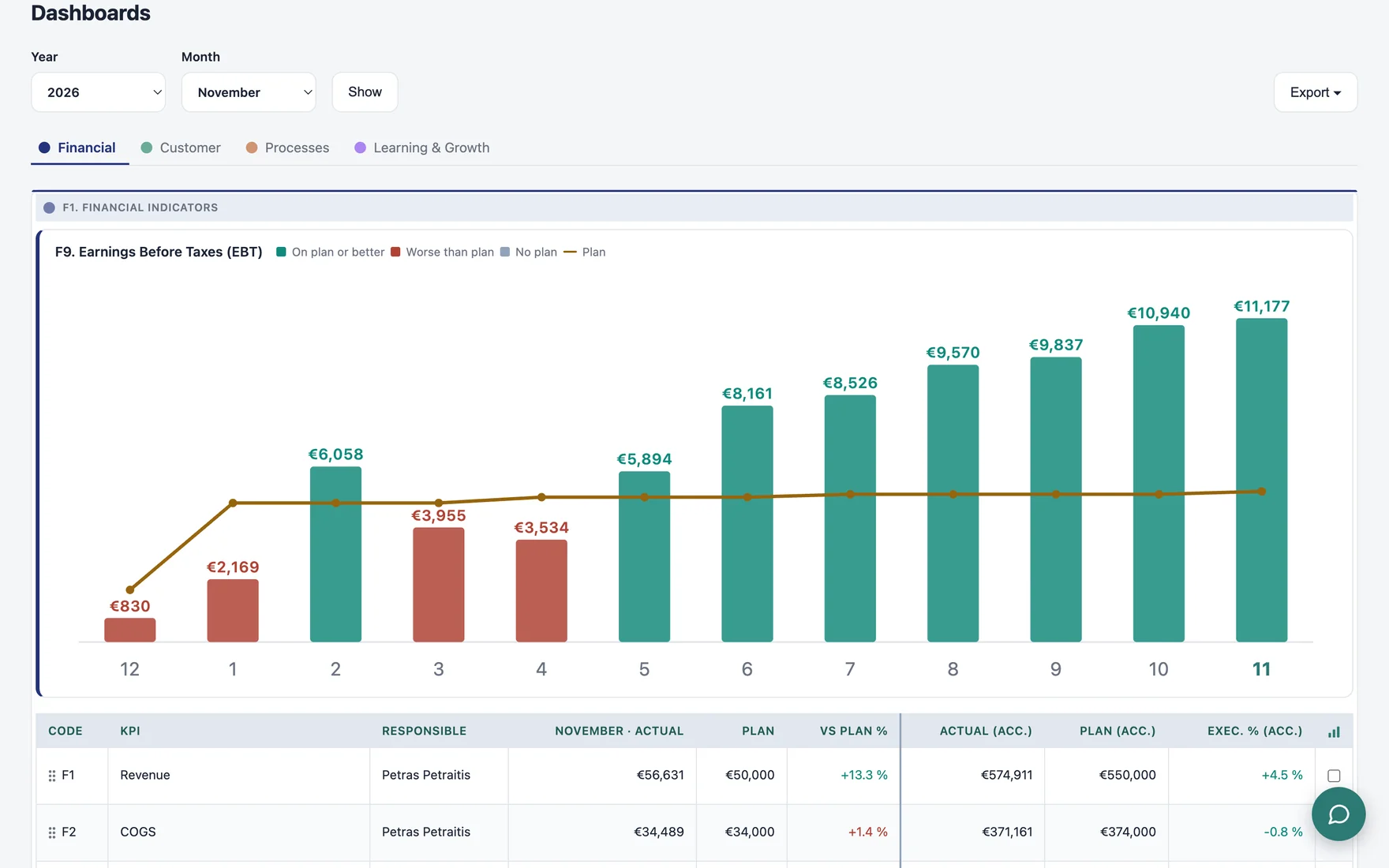
Trailing twelve months of actual versus plan, year-to-date accumulation, informational KPIs compared with the previous year. No vanity charts.
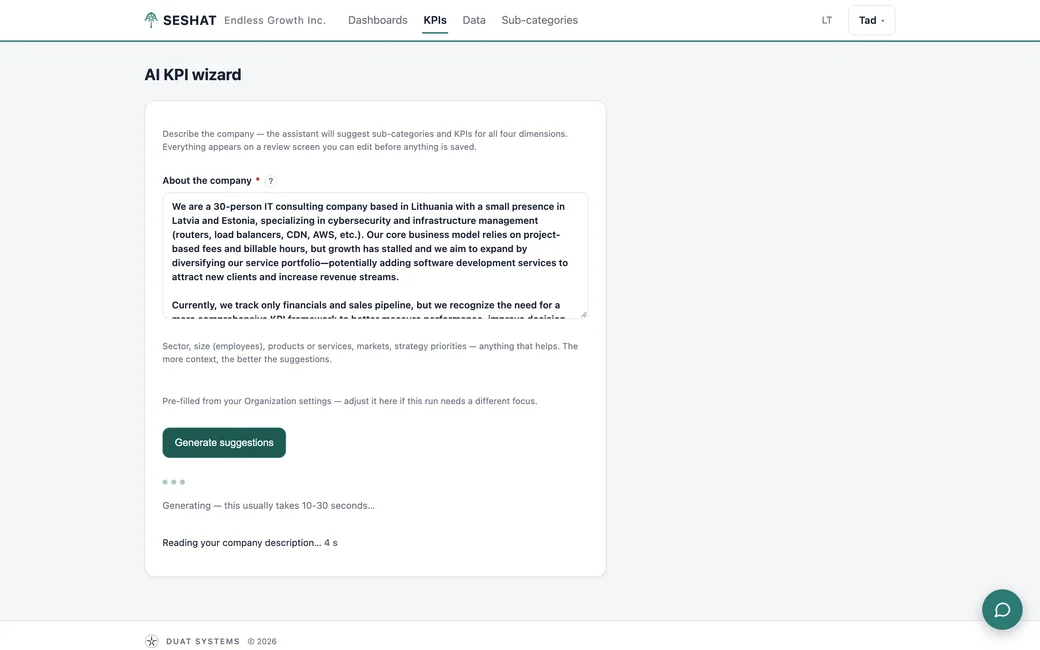
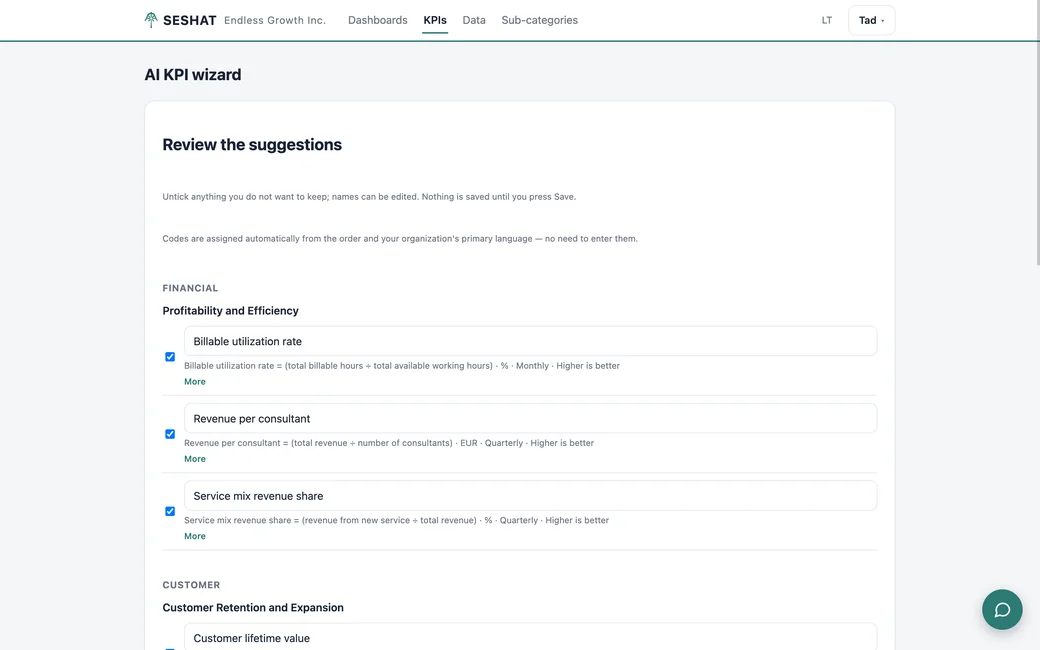
Describe your company and the assistant proposes sub-categories and KPIs for all four dimensions. You review and edit everything before a single value is saved.
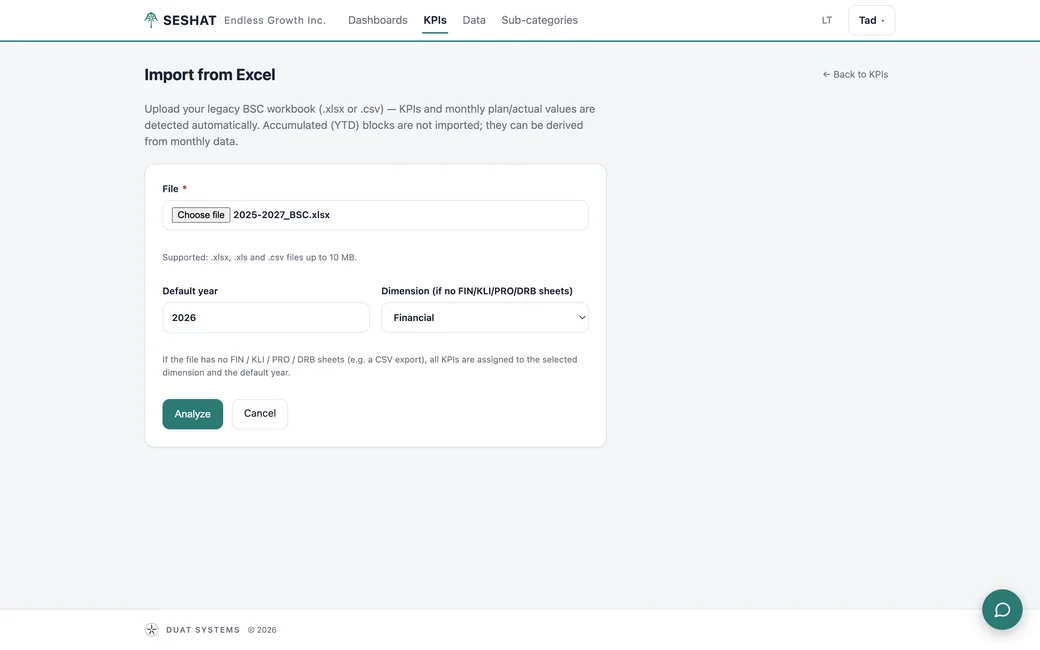
Bring the scorecard you already keep. Workbooks and CSV files with KPI lists and monthly values are recognized automatically, history included.
Comments with #KPI mentions keep the conversation attached to the data it concerns, so decisions leave a trace.
Any dashboard exports to PowerPoint (PPTX) or PDF, in the same layout the team sees. The board gets the same truth.
Google and Microsoft Entra sign-in, two-factor authentication required for administrators, and strict per-organization isolation of data.
Inside the workshop
Describe the company, review the suggestions, or bring the scorecard you already keep. The first scorecard takes an afternoon, not a consulting engagement.


The Duat family
Seshat records the passage. She works beside two others.
The dark passage of transformation every organization must cross. The family lives here.
The balanced scorecard platform: objectives cascaded into KPIs, measured monthly, kept honest.
The morning ritual: a few cascaded KPIs per person, reviewed in short daily stand-ups.
Questions
Yes. The four dimensions, the strategy map with its cause-and-effect chain, twenty to thirty indicators for a mid-sized organization. Seshat is that method, without the spreadsheet surgery.
Good — you are halfway there. The import wizard recognizes KPI lists and monthly values in .xlsx and .csv files, and the history comes with them.
The AI KPI wizard proposes a starter set for all four dimensions from a short description of your company. You review and edit before anything is saved — a workshop, not a lecture.
Every organization's workspace is strictly isolated, administrator sign-in is protected by mandatory two-factor authentication, and the privacy policy is published on this site.
Dashboards export to PowerPoint (PPTX) and PDF, in the same layout the team uses. No “as of yesterday” screenshots.
English and Lithuanian across the interface, the comments and the exports. Lithuanian organizations get a scorecard in their own language — diacritics included.
We onboard the first cohort of customers personally: your scorecard is set up together with us and reviewed before anyone signs anything.
Seshat · by Duat Systems · info@duat.systems